 Quality instead of quantity!
 9,500 independent products
 No mainstream
 No mainstream here




Coffee drinks from A to Z: The big encyclopedia of all coffee drinks

The most important facts summarized for you:
- Most coffee drinks are based on just two fundamentals: espresso or filter coffee - the differences come from milk, water and extras.
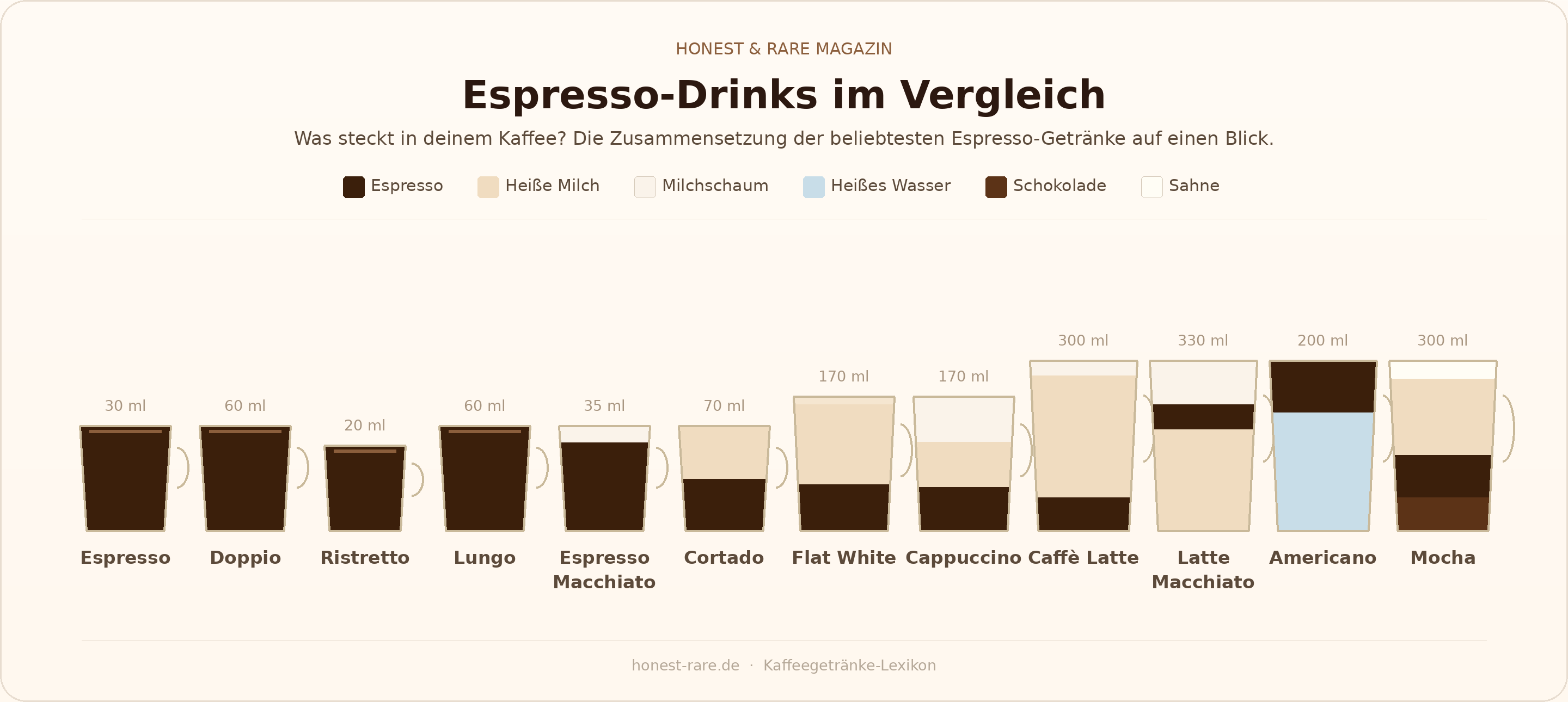
- Cappuccino, latte macchiato and flat white differ mainly in the ratio of espresso, milk and milk foam.
- Cold brew is not the same as iced coffee - cold brew is extracted cold over many hours and tastes milder and less acidic.
- Coffee drinks with alcohol, such as Irish coffee or the North German Pharisee, have a long tradition and are more than just mixed drinks.
- There are fascinating coffee specialties around the world - from Vietnamese egg coffee to Hong Kong yuanyang made from coffee and tea.
- The preparation method has a huge impact on the taste: French press, pour-over, mocha pot and espresso machine all produce completely different results from the same bean.
Espresso, cappuccino, flat white, cold brew - the world of coffee drinks is huge and can sometimes be quite confusing. What exactly is the difference between a latte macchiato and a caffè latte? Is a long black the same as an Americano? And what on earth is a cortado?
Don't worry: we'll bring order to the coffee chaos. In this encyclopedia, we explain all the important coffee drinks - from espresso classics and the most popular lattes to cold coffee drinks, alcoholic coffee creations and international specialties that you should definitely try. There are also the most important facts for each drink at a glance: What is it made of, how intense does it taste, how big is the portion and how much milk is in it?
At the end of the article, we also take a look at the different preparation methods - because whether it's a portafilter, French press or mocha pot: The brewing method has a huge impact on how your coffee tastes.
Table of contents
Pure espresso
Espresso - Doppio - Ristretto - Lungo - Espresso con Panna
Espresso with milk
Cappuccino - Caffè Latte - Latte Macchiato - Espresso Macchiato - Flat White - Cortado - Piccolo - Café au Lait - Galão - Breve - Mocha - Marocchino
Espresso with water
Americano - Long Black
Espresso with extras
Affogato - Red Eye
Cold coffee drinks
Cold Brew - Nitro Cold Brew - Iced Coffee - Japanese Iced Coffee - Iced Coffee (German) - Iced Latte - Iced Americano - Frappé - Frappuccino - Espresso Tonic - Café con Hielo - Dalgona Coffee
Coffee drinks with alcohol
Irish coffee - Pharisee - Café Corretto - Rüdesheim coffee - Carajillo - Bavarian coffee
International niche specialties - small but wow
Einspänner - Vietnamese iced coffee - Vietnamese egg coffee - Café Bombón - Café de Olla - Café Cubano - Yuanyang - Kopi
Overview of preparation methods
Espresso machine (portafilter) - Fully automatic - Mocha pot / espresso maker - French press - Pour-over / hand filter - AeroPress - Filter coffee machine - Turkish / Greek preparation - Karlovy Vary pot - Cold brew method - Siphon / vacuum brewer - Vietnamese Phin filter
Pure espresso
Espresso
Also known as: Short Black
Espresso is the centerpiece of coffee culture and the basis for almost all the coffee drinks you will find in this encyclopedia. In Italy - its homeland - it is drunk several times a day, often standing at the bar. Small, strong and with a characteristic crema on the surface: a good espresso is an experience in concentrated form.
The first espresso machine was patented in Italy in 1884. Angelo Moriondo is considered the inventor, but it was the further development by Luigi Bezzera and Achille Gaggia in the 1940s that made espresso the way we know it today.
| The basis | espresso |
| Preparation | Hot water is pressed through finely ground coffee powder under high pressure (approx. 9 bar). Result: approx. 25-30 ml in about 25 seconds. |
| Served | Warm |
| Milk content | None |
| Portion size | Approx. 25-30 ml |
| Intensity | Strong |
Doppio
Also known as: Double espresso
The Doppio is simply a double espresso - two shots in one cup. If you love the taste of an espresso but want a little bit more of it, go for the Doppio. In many coffee shops, the doppio is now the standard when ordering an "espresso".
| Base | espresso |
| Preparation | Two shots of espresso, extracted one after the other or simultaneously in a double strainer. |
| Served | Warm |
| Milk content | None |
| Serving size | Approx. 50-60 ml |
| Intensity | Strong |
Ristretto
The ristretto is the espresso's little, even more intense brother. The same amount of coffee powder, but only half the water - the result is an extremely concentrated shot with fewer bitter substances and more sweetness. In Italy, it is considered by connoisseurs to be the purest form of coffee enjoyment. Due to the shorter extraction time, fewer bitter substances are dissolved - the ristretto often tastes sweeter and fruitier than an espresso.
| Base | espresso |
| Preparation | Like an espresso, but with half the amount of water (approx. 15-20 ml). The extraction is stopped earlier. |
| Served | Warm |
| Milk content | None |
| Portion size | Approx. 15-20 ml |
| Intensity | Very strong |
Lungo
The lungo takes the opposite approach to the ristretto: more water, same amount of coffee powder. The result is a larger, milder espresso - but be careful: the longer extraction time can also release more bitter substances. A lungo is not a "watered-down espresso", but a drink in its own right with a different taste profile.
| Base | espresso |
| Preparation | Espresso with double the amount of water (approx. 50-60 ml). The extraction runs longer. |
| Served | Warm |
| Milk content | None |
| Portion size | Approx. 50-60 ml |
| Intensity | Medium |
Espresso con panna
Espresso with whipped cream - so simple, so good. The Espresso con Panna combines the intensity of an espresso with the sweetness and creaminess of whipped cream. In Vienna, a similar variant is known as Einspänner (see international specialties).
| Base | espresso |
| Preparation | A single or double espresso, topped with a dollop of whipped cream. |
| Served | Warm |
| Milk content | None (cream instead of milk) |
| Serving size | Approx. 30-40 ml |
| Intensity | Strong |
Espresso with milk
Cappuccino
Alongside espresso, the cappuccino is probably the best-known classic coffee in the world - and like so much else, it comes from Italy. The perfect cappuccino consists of equal parts espresso, hot milk and milk foam. This rule of thirds ensures a wonderful balance between coffee aroma and creamy mildness. In Italy, by the way, cappuccinos are only drunk in the morning - ordering a cappuccino after lunch raises eyebrows there.
The name derives from the Capuchin monks, whose brown robes were reminiscent of the color of the drink. In its current form, the cappuccino spread from Italy to the rest of the world from the 1950s onwards.
| Base | espresso |
| Preparation | One shot of espresso, one third hot milk, one third firm, creamy milk foam. |
| Served | Warm |
| Milk content | Medium |
| Portion size | Approx. 150-180 ml |
| Intensity | Medium |
Caffè Latte
Also known as: Latte, milk coffee
The caffè latte is the milder, milkier relative of the cappuccino. More milk, less foam - this makes it the perfect drink for anyone who likes the taste of coffee but doesn't need it to be too intense. It is also the most popular canvas for latte art in coffee shops. Important: In Italy, you should never order just "a latte" - otherwise you will get a glass of milk.
| Base | espresso |
| Preparation | A shot of espresso with plenty of frothed milk (ratio approx. 1:3 to 1:4) and a thin layer of foam on top. |
| Served | Warm |
| Milk content | High |
| Portion size | Approx. 250-350 ml |
| Intensity | Mild |
Latte Macchiato
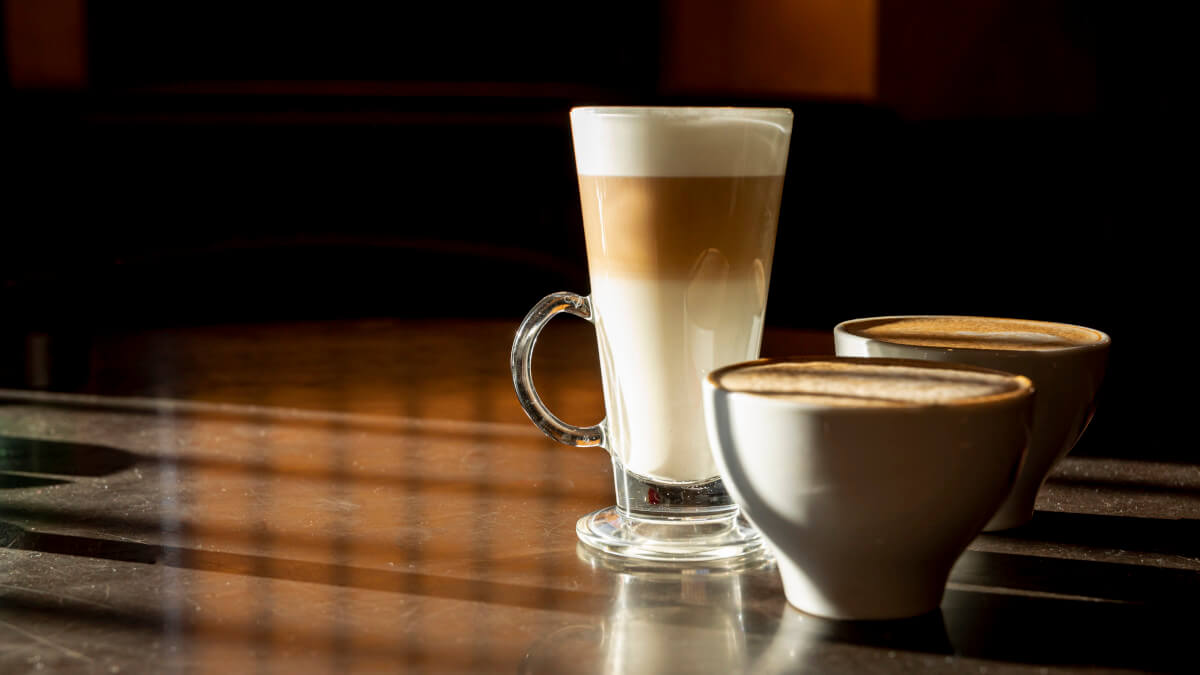
The latte macchiato is the big brother of the caffè latte - and differs mainly in the preparation sequence and appearance. Here, the frothed milk is poured into the glass first and then the espresso is carefully poured through. This creates the typical three layers: Milk at the bottom, espresso in the middle, foam on top. The latte macchiato is particularly popular in Germany and has been an integral part of café culture since the 2000s.
| Base | espresso |
| Preparation | First pour hot, frothed milk into the glass. Then slowly pour a shot of espresso through the foam so that visible layers form. |
| Served | Warm |
| Milk content | High |
| Serving size | Approx. 300-350 ml |
| Intensity | Mild |
Espresso Macchiato
Also known as: Caffè Macchiato
"Macchiato" means "spotted" in Italian - and that describes this drink perfectly. An espresso macchiato is an espresso with just a small dollop of milk foam on top. Not to be confused with the latte macchiato: the espresso macchiato is small, strong and clearly an espresso drink. If you love pure espresso but want to round it off a little, this is the right drink for you.
| Base | espresso |
| Preparation | A shot of espresso with a small spoonful of milk foam. |
| Served | Warm |
| Milk content | Low |
| Serving size | Approx. 35-40 ml |
| Intensity | Strong |
Flat White
The Flat White is the drink for anyone who finds a cappuccino too frothy and a latte too milky. Originating in the coffee culture of Australia and New Zealand, it consists of a double espresso with velvety frothed milk - but with virtually no froth. The result is a compact, strong espresso drink with a silky, creamy texture. Since the 2010s, the flat white has conquered coffee shops around the world.
Whether the flat white was invented in Australia or New Zealand is still disputed today and is the subject of passionate debate between the two countries. There is evidence that it first appeared on menus in the 1980s.
| Base | Espresso (Doppio) |
| Preparation | Double espresso with finely frothed milk (microfoam) without a significant head of foam. Ratio approx. 1:2. |
| Served | Warm |
| Milk content | Medium |
| Portion size | Approx. 150-180 ml |
| Intensity | Strong |
Cortado
The cortado is a small, fine drink from the Spanish coffee culture: an espresso, "cut" (Spanish: cortar) with an equal amount of warm milk. No foam, no gimmicks - just espresso and milk in perfect balance. The cortado is the ideal drink for anyone who finds pure espresso too strong but doesn't want to drown it in milk.
| Base | espresso |
| Preparation | One shot of espresso with the same amount of slightly warmed milk (1:1 ratio). Little to no milk foam. |
| Served | Warm |
| Milk content | Medium |
| Portion size | Approx. 60-70 ml |
| Intensity | Strong |
| Distribution | Spain, Portugal, Latin America, now in specialty coffee shops worldwide |
Piccolo
Also known as: Piccolo Latte
The piccolo is basically a mini latte: a ristretto (or simple espresso) with a small amount of finely frothed milk in a small cup or espresso glass. It originated in the Australian barista scene as a way of testing new roasts without having to drink through large milk drinks. Today, it is an integral part of many specialty coffee menus.
| Base | Espresso (ristretto) |
| Preparation | A ristretto or espresso with a small amount of Microfoam milk in an espresso cup. |
| Served | Warm |
| Milk content | Medium |
| Serving size | Approx. 80-100 ml |
| Intensity | Strong |
Café au Lait
Also known as: Coffee with milk, bowl
Café au lait is the French classic par excellence: strong filter coffee with hot milk in equal parts, traditionally served in a large bowl. Unlike most other café au lait drinks, it is not based on espresso, but on filter coffee or French press coffee. In France, it is an integral part of breakfast - often served with a croissant or a piece of baguette to dunk in.
| Base | Filter coffee |
| Preparation | Strong filter coffee and hot milk in equal parts, often poured at the same time. |
| Served | Warm |
| Milk content | High |
| Portion size | Approx. 250-350 ml |
| Intensity | Mild to medium |
| Distribution | France, but also very common in German cafés as "milk coffee" |
Galão
Galão is the Portuguese equivalent of the caffè latte - but with even more milk. In Portugal, it is the standard drink for breakfast or an afternoon coffee break. It is served in a tall glass and consists of a quarter espresso and three quarters frothed milk.
| Base | espresso |
| Preparation | One shot of espresso with three times the amount of frothed milk in the glass. |
| Served | Warm |
| Milk content | High |
| Serving size | Approx. 200-250 ml |
| Intensity | Mild |
| Distribution | Portugal |
Breve
Also known as: Café Breve
The Breve is an American version of the Caffè Latte - with one decisive difference: instead of milk, half-and-half (a mixture of milk and cream) is used. The result is much creamier and richer than a normal latte. The Breve is not very common in Europe, but is a popular order in American coffee shops.
| Base | espresso |
| Preparation | A shot of espresso with frothed half-and-half (milk-cream mixture). |
| Served | Warm |
| Milk content | High |
| Serving size | Approx. 250-350 ml |
| Intensity | Mild |
| Distribution | USA |
Mocha
Also known as: Mocaccino, Caffè Mocha
Mocha bridges the gap between coffee and cocoa: an espresso drink with chocolate, milk and often cream. Those who like it sweet and chocolaty will love the mocha. It is less of a classic coffee and more of an indulgent hot drink - perfect for cold afternoons or as a dessert substitute. It is also available as an iced mocha in many coffee shops.
The name goes back to the Yemeni port city of Mocha (al-Mukha), which was a center of the coffee trade in the 15th and 16th centuries. The coffee beans from Mocha naturally had a slightly chocolaty note - this later gave rise to the idea of combining coffee and chocolate.
| Base | espresso |
| Preparation | A shot of espresso with chocolate syrup or cocoa powder, frothed milk and optional whipped cream on top. |
| Served | Warm (also cold as an iced mocha) |
| Milk content | High |
| Portion size | Approx. 250-350 ml |
| Intensity | Mild |
Marocchino
A small, chocolaty espresso drink from Piedmont in northern Italy. The Marocchino consists of an espresso, a layer of cocoa powder and a dash of frothed milk - served in a small glass. It is less sweet than a mocha and much smaller, but at least as enjoyable.
| Base | espresso |
| Preparation | Pour the cocoa powder into the glass, pour over the espresso and top with a dash of frothed milk. |
| Served | Warm |
| Milk content | Low |
| Serving size | Approx. 60-80 ml |
| Intensity | Strong |
| Distribution | Italy, especially Piedmont |
Espresso with water
Americano
Also known as: Caffè Americano
The Americano is the answer for those who like espresso but want a larger cup of coffee. One or two shots of espresso are infused with hot water - this smoothes out the intensity and creates a drink that is somewhere between espresso and filter coffee in terms of taste. The Americano is particularly popular in the USA and Great Britain, where it is often drunk as an alternative to filter coffee.
Legend has it that the Americano was created during the Second World War when American soldiers in Italy diluted the espresso, which was too strong for them, with hot water in order to obtain a drink that was reminiscent of their usual filter coffee.
| Base | espresso |
| Preparation | Pour one or two shots of espresso into a large cup and fill up with hot water (ratio approx. 1:2 to 1:3). |
| Served | Warm |
| Milk content | None |
| Serving size | Approx. 150-250 ml |
| Intensity | Medium |
Long Black
The Long Black is the Australian-New Zealand brother of the Americano - with a decisive difference in preparation: here, the hot water is poured into the cup first and then the espresso is pulled over it. It sounds like a trifle, but it makes a difference to the taste: the crema is better preserved and the drink generally tastes a little fuller and more aromatic than an Americano.
| Base | Espresso (Doppio) |
| Preparation | First pour hot water into the cup, then carefully extract a double espresso over it. |
| Served | Warm |
| Milk content | None |
| Serving size | Approx. 150-200 ml |
| Intensity | Strong |
| Distribution | Australia, New Zealand |
Espresso with extras
Affogato
Is it a coffee? Is it a dessert? It's both! The affogato (Italian for "drowned") consists of a scoop of vanilla ice cream drowned in a shot of hot espresso. The combination of hot and cold, bitter and sweet, creamy and intense is simply brilliant. In Italy, the affogato is often served as a dolce after a meal.
| Base | espresso |
| Preparation | Place a scoop of vanilla ice cream (or fior di latte) in a glass or bowl and pour a shot of hot espresso over it. |
| Served | Hot-cold combination |
| Milk content | None (but ice cream) |
| Serving size | Approx. 100 ml |
| Intensity | Strong |
Red Eye
Also known as: Shot in the Dark
The Red Eye is the most caffeinated drink on this list - and not for the faint-hearted. A cup of filter coffee with an additional shot of espresso. The name (German: "red eye") refers to night flights, after which you typically land tired and red-eyed and need a good caffeine kick. Some cafés also offer the "Black Eye" (two shots) or the "Dead Eye" (three shots).
| Base | Filter coffee + espresso |
| Preparation | A cup of filter coffee with a shot of espresso in it. |
| Served | Warm |
| Milk content | None |
| Portion size | Approx. 250-300 ml |
| Intensity | Very strong |
Cold coffee drinks
Cold Brew
In recent years, cold brew has risen from a niche drink to an absolute trend coffee. The special thing about it: It is not brewed with hot water, but cold extracted over a long period of time (12-24 hours). The result is a velvety, mildly sweet coffee with significantly less acidity and bitterness than conventionally brewed coffee. Cold brew is usually produced as a concentrate and diluted with water, milk or ice before drinking.
| Base | Filter coffee (cold extracted) |
| Preparation | Allow coarsely ground coffee to steep in cold water for 12-24 hours, then filter. Dilute the concentrate as desired. |
| Served | Cold |
| Milk content | None (optional) |
| Serving size | Approx. 250-400 ml |
| Intensity | Mild to medium (depending on dilution) |
Nitro Cold Brew
Nitro Cold Brew is Cold Brew 2.0: Nitrogen is added to the cold coffee concentrate and served like beer from the tap. The nitrogen creates a velvety, almost creamy texture and an attractive, cascading head of foam - without any milk or sugar. The mouthfeel is reminiscent of Guinness, the taste is soft and slightly sweet.
| Base | Filter coffee (cold extracted, infused with nitrogen) |
| Preparation | Cold-brew concentrate is infused with nitrogen under pressure and tapped from the tap into a glass. |
| Served | Cold |
| Milk content | None |
| Portion size | Approx. 300-400 ml |
| Intensity | Medium |
Iced coffee
Iced coffee is the uncomplicated introduction to the world of cold coffee drinks: freshly brewed coffee that is cooled and served over ice cubes. Compared to cold brew, iced coffee is more acidic and tastes closer to classic hot coffee. The disadvantage: ice cubes water down the drink if you drink it too slowly. Tip: freeze coffee ice cubes and use them instead of normal ice cubes.
| Base | Filter coffee or espresso |
| Preparation | Allow freshly brewed coffee to cool and serve over ice cubes. Optionally with milk and sugar. |
| Served | Cold |
| Milk content | None to medium (depending on the variant) |
| Portion size | Approx. 250-400 ml |
| Intensity | Medium |
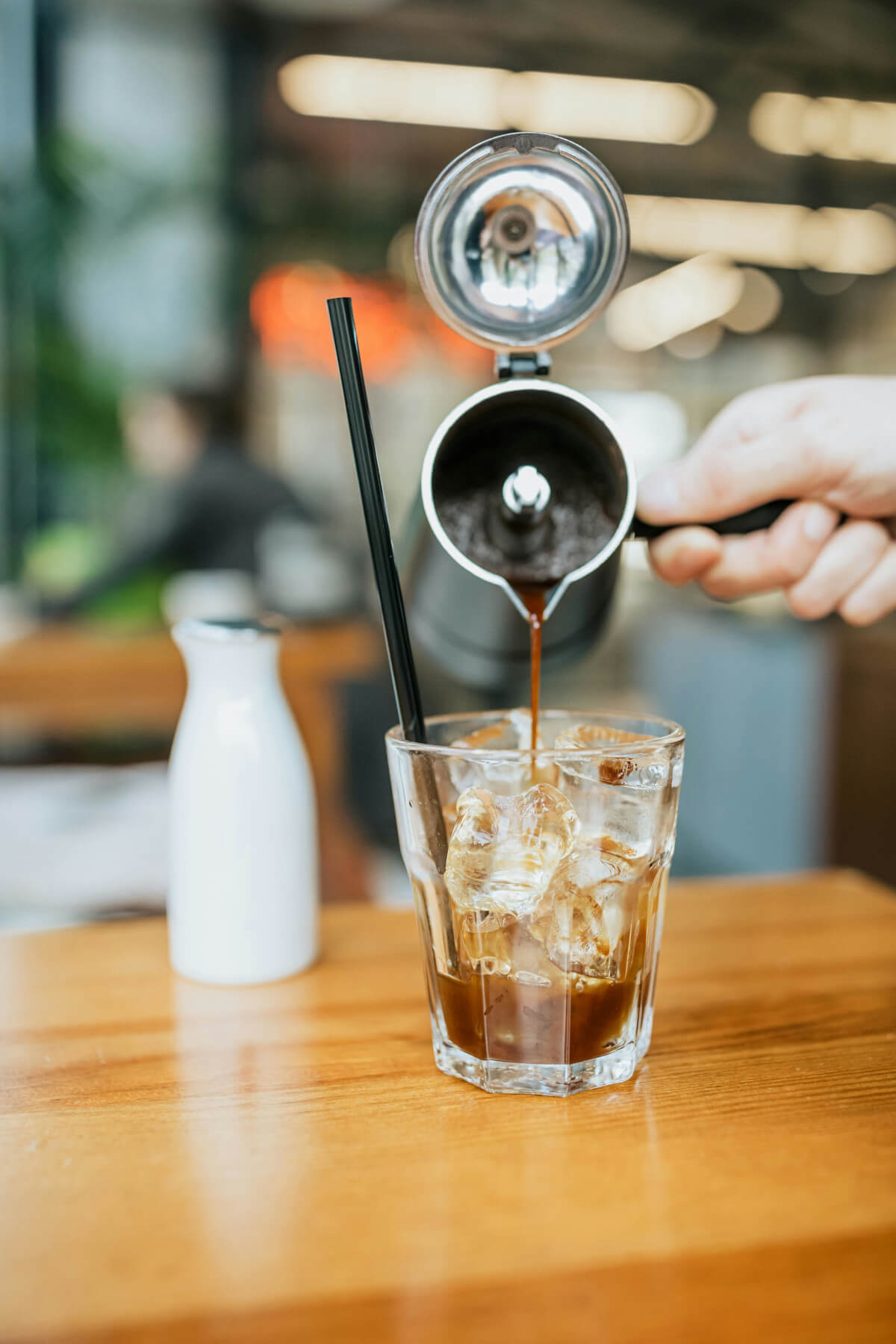
Japanese Iced Coffee
Also known as: Flash Brew
The most elegant method of preparing cold coffee - and highly appreciated in the specialty coffee scene. With Japanese Iced Coffee, the coffee is brewed as a pour-over directly onto ice cubes. The hot coffee is cooled down abruptly, which "freezes" the volatile aromas and creates a much more complex taste profile than with classic iced coffee or cold brew. Fruity, floral notes come out particularly well with this method.
| Base | Filter coffee (pour-over) |
| Preparation | Brew coffee as a hand filter/pour-over directly into a carafe with ice cubes. The amount of coffee is increased to compensate for the dilution caused by the ice. |
| Served | Cold |
| Milk content | None |
| Portion size | Approx. 200-300 ml |
| Intensity | Medium to strong |
Iced coffee (German)
The German iced coffee only has the name in common with an iced coffee - otherwise it is a completely independent drink and more of a dessert than a coffee. Cold coffee forms the basis, with one or two scoops of vanilla ice cream and a dollop of whipped cream. It is served in a tall glass with a straw and long spoon. There is hardly anything better on a hot summer's day in Germany.
| Base | Filter coffee (cold) |
| Preparation | Pour cold, strong coffee into the glass, add scoop(s) of vanilla ice cream and top with whipped cream. Optional: chocolate sprinkles. |
| Served | Cold |
| Milk content | None (but ice cream and whipped cream) |
| Serving size | Approx. 300-400 ml |
| Intensity | Mild |
| Distribution | Germany, Austria, Switzerland |
Iced latte
The iced latte is the cold version of the caffè latte: espresso over ice cubes, topped up with cold milk. Simple, refreshing and one of the most popular summer drinks in coffee shops around the world. Compared to iced coffee, the iced latte is creamier and milder - the milk takes the edge off the espresso.
| Base | espresso |
| Preparation | Pour one or two shots of espresso over ice cubes in a glass and top up with cold milk. |
| Served | Cold |
| Milk content | High |
| Serving size | Approx. 300-400 ml |
| Intensity | Mild |
Iced Americano
The Iced Americano is the summer version of the Americano: espresso over ice cubes, topped up with cold water. Refreshing, pure and with no frills - the drink for anyone who likes cold coffee without milk. Especially in South Korea and Japan, the iced Americano is extremely popular and is drunk at any time of year.
| Base | espresso |
| Preparation | Pour one or two shots of espresso over ice cubes in a glass and top up with cold water. |
| Served | Cold |
| Milk content | None |
| Serving size | Approx. 300-400 ml |
| Intensity | Medium |
| Distribution | Worldwide, particularly popular in South Korea and Japan |
Frappé
Also known as: Greek frappé
Frappé is a Greek national drink - and one of the few coffee legends based on instant coffee. It was allegedly invented in 1957 at the International Trade Fair in Thessaloniki when a Nestlé employee had no access to hot water and prepared his instant coffee with cold water and ice in a shaker. In Greece, there are three levels of sweetness: Skétos (without sugar), Métrios (medium) and Glykós (sweet).
| Base | Instant coffee |
| Preparation | Shake or mix the instant coffee, sugar and a little cold water vigorously until a thick foam forms. Pour over ice cubes into a tall glass and top up with water and optional milk. |
| Served | Cold |
| Milk content | None to medium (optional) |
| Serving size | Approx. 300-400 ml |
| Intensity | Medium |
| Distribution | Greece, Cyprus |
Frappuccino
Strictly speaking, the Frappuccino is a Starbucks brand name - but has long since become a generic term for blended, cold coffee drinks with ice. In contrast to the Greek frappé, the frappuccino is crushed with ice in a blender and often contains milk, syrup and cream. Less coffee, more dessert - but definitely tempting on hot days.
| Base | Espresso or filter coffee |
| Preparation | Mix coffee, milk, ice and syrup in a blender until a slushie-like consistency is achieved. Serve with cream and topping. |
| Served | Cold |
| Milk content | High |
| Portion size | Approx. 350-500 ml |
| Intensity | Mild |
Espresso Tonic
The espresso tonic is one of the most exciting coffee trends of recent years: a double espresso poured over ice-cold tonic water. The combination sounds unusual at first, but results in a fascinating interplay between the bitterness of the tonic, the sweetness of the espresso and the sparkling carbon dioxide. The drink was invented in Oslo in 2007 and spread around the world via the barista competition scene.
| Base | espresso |
| Preparation | Ice cubes in the glass, tonic water on top, then pour a double espresso slowly over the back of a spoon or directly into the glass. |
| Served | Cold |
| Milk content | None |
| Serving size | Approx. 200-300 ml |
| Intensity | Medium to strong |
Café con Hielo
Café con Hielo (Spanish for "coffee with ice") is the typical Spanish way to drink cold coffee - and charmingly uncomplicated. You order an espresso and are served a separate glass with ice cubes. You then pour the espresso over the ice yourself. In Spain, it is as much a part of everyday life in the summer months as the siesta.
| Base | espresso |
| Preparation | An espresso is served separately and poured by the guest over a glass with ice cubes. |
| Served | Cold |
| Milk content | None |
| Portion size | Approx. 100-150 ml |
| Intensity | Strong |
| Distribution | Spain |
Dalgona Coffee
Also known as: Whipped coffee
Dalgona Coffee became a viral sensation in 2020 - a TikTok drink that conquered the world during the coronavirus lockdowns. It is very easy to prepare: instant coffee, sugar and hot water are mixed in equal parts and whisked until a thick, creamy foam forms. This is then poured onto cold (or warm) milk. Visually spectacular, sweet and strong at the same time.
The name comes from the Korean caramel sweet Dalgona. The drink went viral after South Korean actor Jung Il-Woo drank it on a TV show in 2020.
| Base | Instant coffee |
| Preparation | Whisk 2 tablespoons of instant coffee, sugar and hot water with a whisk or blender to a firm foam. Pour over a glass of milk (with or without ice). |
| Served | Cold (can also be served warm) |
| Milk content | High |
| Serving size | Approx. 250-350 ml |
| Intensity | Medium |
Coffee drinks with alcohol
Irish Coffee
Probably the most famous alcoholic coffee in the world: hot, strong coffee, brown sugar, Irish whiskey and a topping of lightly whipped cream. Irish coffee is not a simple coffee with a shot, but a carefully layered drink - the cream floats on top and you drink the warm, sweet whiskey coffee through the cold cream.
Invented in the 1940s by Joe Sheridan, a chef at Foynes Airport (now Shannon) in Ireland. He served the drink to freezing American passengers waiting on a stopover.
| Base | Filter coffee |
| Preparation | Pour hot, strong coffee with brown sugar into a pre-warmed glass and stir in a dash of Irish whiskey. Carefully slide the lightly whipped cream over the back of a spoon onto the coffee. |
| Served | Warm |
| Milk content | None (but cream) |
| Serving size | Approx. 200-250 ml |
| Intensity | Medium |
Pharisee
The Pharisäer is a North German original and one of the greatest coffee concoctions in the history of drinks. The preparation: strong coffee, a good shot of rum and a dollop of cream on top - and here's the trick: the cream topping is supposed to mask the rum aroma. Traditionally, the Pharisee should not be stirred, but drunk through the cream.
Legend has it that it was invented on the North Frisian island of Nordstrand. The strict pastor Georg Bleyer did not tolerate alcohol - so the parishioners hid the rum under a cap of cream. When the pastor discovered the deception, he shouted indignantly: "You Pharisees!" The name stuck.
| The basis | Filter coffee |
| Preparation | Mix strong coffee with sugar and a good dash of brown rum. Cover with a thick layer of whipped cream. Do not stir! |
| Served | Warm |
| Milk content | None (but cream) |
| Portion size | Approx. 200-250 ml |
| Intensity | Medium |
| Distribution | Northern Germany, especially North Friesland |
Café Corretto
In Italy, people like to order a café corretto after a meal - an espresso "corrected" with a shot of grappa, sambuca or another digestif. Not a complicated mixed drink, but a simple, effective combination that is part of everyday life in Italy.
| Base | espresso |
| Preparation | An espresso with a shot (approx. 20-30 ml) of grappa, sambuca or another liqueur. |
| Served | Warm |
| Milk content | None |
| Serving size | Approx. 50-60 ml |
| Intensity | Strong |
| Distribution | Italy |
Rüdesheim coffee
Rüdesheim coffee is a rich German specialty coffee drink that originated in the Rheingau. Asbach Uralt brandy is flambéed in the cup, caramelized with sugar, then infused with strong coffee and topped with cream and chocolate shavings. More of a show than a quick caffeine fix - but that's exactly what makes it such a special treat.
Created in 1957 by Hans Karl Adam for the Asbach restaurant in Rüdesheim am Rhein. The original recipe is protected by trademark.
| Base | Filter coffee |
| Preparation | Flambé Asbach brandy with sugar cubes in a cup, pour in hot coffee, garnish with whipped cream and chocolate shavings. |
| Served | Warm |
| Milk content | None (but cream) |
| Serving size | Approx. 200-250 ml |
| Intensity | Medium |
| Distribution | Rheingau, Germany |
Carajillo
The carajillo is the Spanish counterpart to the café corretto: an espresso with a shot of brandy or liqueur. In Spain, it is traditionally served with Brandy de Jerez, in Mexico often with Licor 43, which gives it a vanilla-sweet note. Carajillo is popular throughout the Spanish-speaking world and is drunk both warm and over ice.
| Base | espresso |
| Preparation | A shot of espresso with a shot of brandy, rum or liqueur (e.g. Licor 43). Served either warm or shaken over ice. |
| Served | Warm or cold |
| Milk content | None |
| Portion size | Approx. 60-100 ml |
| Intensity | Strong |
| Distribution | Spain, Mexico, Latin America |
Bavarian coffee
A lesser-known but wonderfully enjoyable member of the alcoholic coffee family: strong coffee with kirsch, sugar and a topping of cream. Bavarian coffee combines coffee culture with the Bavarian fruit brandy tradition and is often served in the Alpine regions.
| Base | Filter coffee |
| Preparation | Pour hot coffee with sugar and a dash of kirsch into a glass. Top with whipped cream. |
| Served | Warm |
| Milk content | None (but cream) |
| Portion size | Approx. 200-250 ml |
| Intensity | Medium |
| Distribution | Bavaria, Alpine region |
International niche specialties - small but wow
Single harness
Also known as: Viennese coffee, Vienna coffee
The Einspänner is the flagship of Viennese coffee house culture: a strong espresso (called "mocha" in Vienna), served in a glass and topped with a generous dollop of whipped cream. The name means "one-horse carriage" - the drink was originally intended for Viennese horse-drawn carriage drivers who only had one hand free. The cream kept the coffee warm while they drove through the cold Viennese streets.
Originated in the Viennese coffee houses of the 19th century. In the 2020s, the one-horse carriage experienced an international revival, especially in the South Korean coffee scene.
| Base | Espresso (mocha) |
| Preparation | Strong espresso in a glass, generously topped with whipped cream. Optional: powdered sugar on the cream. |
| Served | Warm |
| Milk content | None (but cream) |
| Serving size | Approx. 150-200 ml |
| Intensity | Strong |
| Distribution | Austria, especially Vienna |
Vietnamese iced coffee
Also known as: Cà Phê Sữa Đá
One of the most ingenious coffee drinks in the world - and addictively good. Strong, dark-roasted coffee (traditionally Robusta) is slowly dripped through a Phin filter onto a generous layer of sweetened condensed milk. Stir, add ice and you have a drink that is sweet, bitter, creamy and refreshing all at the same time. In Vietnam, Cà Phê Sữa Đá can be found on literally every street corner.
| Base | Filter coffee (Phin filter) |
| Preparation | Drip Vietnamese coffee (dark roast, often Robusta) through a phin filter onto sweetened condensed milk. Serve with ice cubes. |
| Served | Cold |
| Milk content | High (condensed milk) |
| Serving size | Approx. 200-300 ml |
| Intensity | Strong |
| Distribution | Vietnam, now available worldwide in Vietnamese restaurants and specialty cafés |
Vietnamese egg coffee
Also known as: Cà Phê Trứng
Coffee with egg - sounds strange, but tastes sensational. Cà Phê Trứng is a specialty from Hanoi: egg yolks are whipped with sweetened condensed milk and sugar to a thick, creamy mass and placed on a strong espresso or filter coffee. The result is reminiscent of liquid tiramisu. It is traditionally served in a small cup placed in a bowl of warm water to maintain the temperature.
It is said to have originated in the 1940s when fresh milk was in short supply in Vietnam and egg yolks served as a creamy substitute.
| Base | Espresso or strong filter coffee |
| Preparation | Whisk the egg yolks with sweetened condensed milk and sugar until a thick cream forms. Pour over a shot of espresso or strong coffee. |
| Served | Warm |
| Milk content | Medium (condensed milk + egg) |
| Serving size | Approx. 120-150 ml |
| Intensity | Strong |
| Distribution | Vietnam, especially Hanoi |
Café Bombón
Café Bombón is the sweetest temptation in Spanish coffee culture: an espresso layered on top of an equal amount of sweetened condensed milk, served in a small glass. The two layers - dark on top, creamy white on the bottom - create a pretty look. Stir before drinking and experience the sweet and bitter pleasure.
| Base | espresso |
| Preparation | Pour sweetened condensed milk into the glass and slowly layer the espresso on top (1:1 ratio). |
| Served | Warm |
| Milk content | High (condensed milk) |
| Serving size | Approx. 60-80 ml |
| Intensity | Strong (but sweet) |
| Distribution | Spain, especially Valencia and Levante |
Café de Olla
This warming, spicy coffee comes from Mexico and is traditionally prepared in a clay pot (olla de barro). The coffee is cooked with cinnamon sticks and piloncillo (unrefined cane sugar) - the result is a sweet, aromatic coffee with a distinct cinnamon note and an earthy character, which is added by the clay pot.
| Base | Filter coffee (boiled) |
| Preparation | Boil coarsely ground coffee with water, cinnamon sticks and piloncillo in a pot (traditionally a clay pot) and leave to infuse. Pour through a sieve. |
| Served | Warm |
| Milk content | None |
| Portion size | Approx. 150-200 ml |
| Intensity | Medium |
| Distribution | Mexico |
Café Cubano
Also known as: Cafecito
The cafecito is an important part of Cuban culture and social life. At its core, it is a strong, sweet espresso - but what makes it special is the espuma: when brewing, the first drops of espresso are mixed with plenty of sugar to form a caramelly, foamy paste before the rest of the espresso is poured over it. The result is a sweet, strong coffee with a creamy head of foam.
| Base | espresso |
| Preparation | Stir the first drops of espresso with sugar vigorously to form a light brown paste (espuma). Pour over the remaining espresso. |
| Served | Warm |
| Milk content | None |
| Serving size | Approx. 50-80 ml |
| Intensity | Strong |
| Distribution | Cuba, Miami, Cuban diaspora |
Yuanyang
In Hong Kong, coffee and tea are not only drunk side by side, but preferably at the same time: Yuanyang is a blend of strong coffee and Hong Kong milk tea (a strong black tea with condensed milk). The name refers to Mandarin ducks, which always appear as a pair - like coffee and tea in this unusual drink. The result is surprisingly harmonious: malty, sweet, strong and a real caffeine kick.
| Base | Filter coffee + black tea |
| Preparation | Mix strong coffee and strong black tea (e.g. Ceylon or Assam) in roughly equal parts. Serve with sweetened condensed milk or evaporated milk. |
| Served | Warm or cold |
| Milk content | Medium (evaporated milk) |
| Serving size | Approx. 200-300 ml |
| Intensity | Strong |
| Distribution | Hong Kong, South East Asia |
Kopi
In many parts of Southeast Asia, "kopi" simply means "coffee" - but the way it is prepared is unique. Traditionally, the coffee beans are roasted with butter or margarine and sugar, which gives them a caramelly, full-bodied aroma. The coffee is then brewed using a cloth filter and typically served with sweetened condensed milk. In Malaysia and Singapore, kopi is the standard at every kopitiam (coffee house).
| Basic | Filter coffee (cloth filter) |
| Preparation | Brew butter-roasted coffee beans with a cloth filter. Serve with sweetened condensed milk or evaporated milk. |
| Served | Warm or cold |
| Milk content | High (evaporated milk) |
| Serving size | Approx. 150-200 ml |
| Intensity | Strong |
| Distribution | Malaysia, Singapore, Indonesia |
Overview of preparation methods
The way in which coffee is prepared has at least as much influence on the taste as the bean itself. The same roast can taste strong and concentrated as an espresso, but fruity and delicate in a pour-over. Here we introduce you to the most important preparation methods - so that you know what the terms mean.
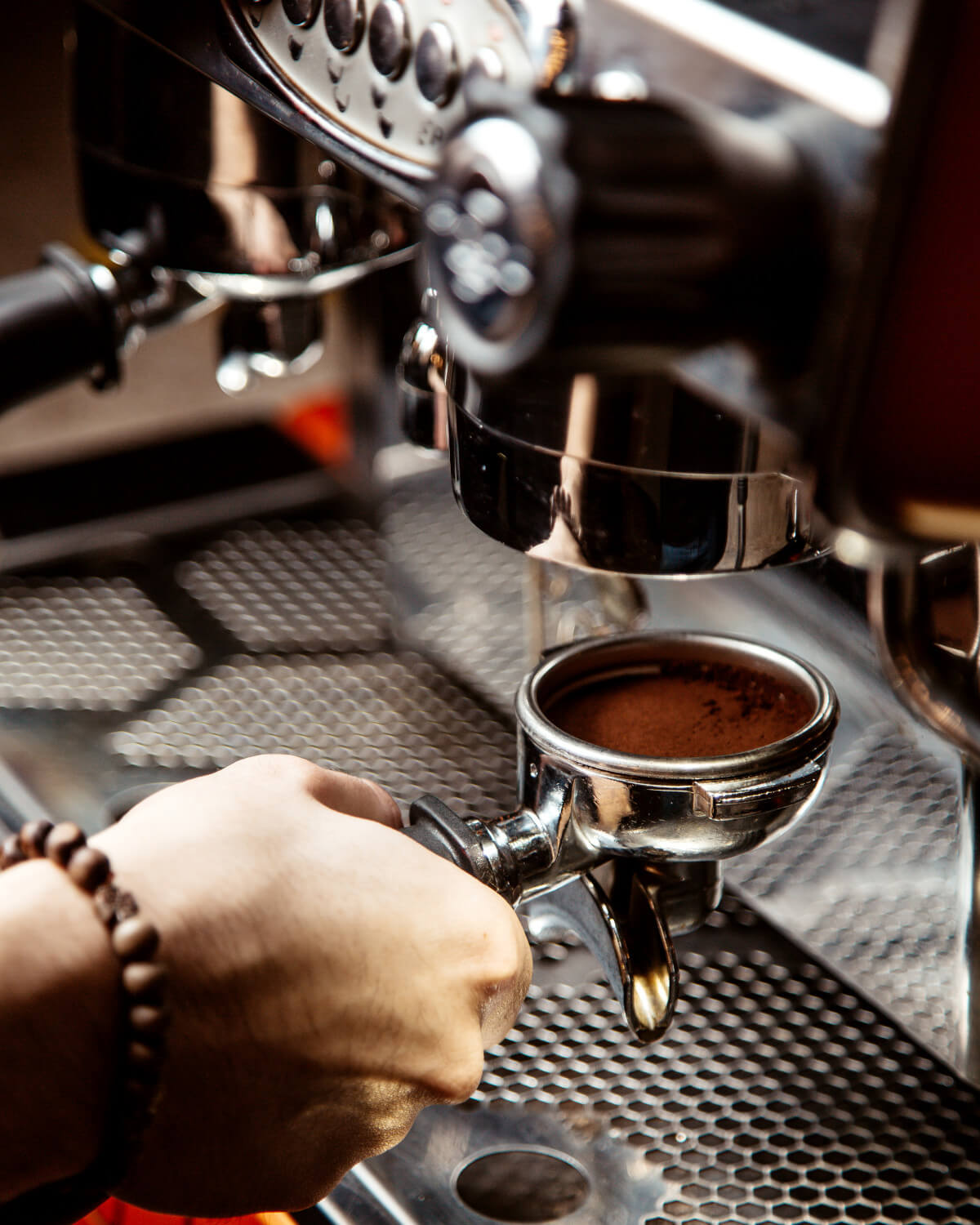
Espresso machine (portafilter)
The premier class of coffee preparation. In a portafilter machine, water is pressed through finely ground coffee powder under high pressure (approx. 9 bar). The result is a concentrated, aromatic espresso with the typical crema. The portafilter machine requires some practice and the right equipment (a good grinder!), but rewards you with the best espresso you can make at home.
| Typical drinks | Espresso, cappuccino, latte, flat white and all espresso-based drinks |
| Grind size | Fine |
| Brewing time | Approx. 25-30 seconds |
| Result | Concentrated, full-bodied, with crema |
Fully automatic
The fully automatic machine does everything at the touch of a button: grind beans, brew espresso, froth milk. Practical, fast and consistent - ideal for everyday use. In terms of taste, a fully automatic machine doesn't quite come close to a good portafilter machine, but delivers significantly better results than capsule machines or filter coffee from a machine.
| Typical drinks | Espresso, caffè crema, cappuccino, latte macchiato |
| Grinding degree | Is adjusted automatically |
| Brewing time | Approx. 25-40 seconds |
| Result | Consistent, suitable for everyday use, good quality |
Mocha pot / espresso maker
Also known as: Bialetti, Moka Pot
The iconic octagonal pot for the stove, which can be found in practically every household in Italy. Water is heated in the lower part and rises to the top as steam through the coffee powder. The result is not a "real" espresso (the pressure is significantly lower), but a strong, full-bodied coffee with its own character. The Bialetti Moka Express from 1933 is the classic.
| Typical drinks | Mocha coffee (can be used as a base for milk drinks) |
| Grind | Medium to fine |
| Brewing time | Approx. 4-5 minutes |
| Result | Strong, full-bodied, slightly metallic (depending on the pot) |
French press
Also known as: French press pot, cafetière
The French press is probably the most uncomplicated way to make good coffee: Pour hot water over coarsely ground coffee, leave to infuse for four minutes, press down the plunger - done. As no paper filter is used, the coffee oils are retained, giving the coffee a full, creamy body. The French press is perfect for anyone who likes uncomplicated, aromatic coffee with character.
| Typical drinks | Filter coffee, café au lait |
| Grind size | Coarse |
| Brewing time | Approx. 4 minutes |
| Result | Full-bodied, oily, strong, slightly cloudy |
Pour-over / hand filter
e.g. V60, Chemex, Kalita Wave, Melitta
Pour-over is the supreme discipline of filter coffee: hot water is poured slowly and in a controlled manner over the coffee powder in the filter in circular movements. This allows extremely precise control over brewing time, water temperature and flow rate - and therefore over the taste. The result differs slightly depending on the appliance (V60, Chemex, Kalita Wave), but all pour-over methods deliver a clear, nuanced coffee that brings out the delicate aromas particularly well.
| Typical drinks | Filter coffee, Japanese iced coffee |
| Grind size | Medium |
| Brewing time | Approx. 2.5-4 minutes |
| Result | Clear, aromatic, nuanced |
AeroPress
The AeroPress is a brewing device invented in 2005 that works using air pressure - a kind of mix between a French press and a pocket-sized espresso machine. It is lightweight, inexpensive, virtually indestructible and delivers a coffee in under two minutes that can be somewhere between espresso and filter coffee, depending on the recipe. In the specialty coffee scene, the AeroPress has a loyal fan base and even its own world championships.
| Typical drinks | Concentrated coffee (espresso-like) or mild filter coffee |
| Grind size | Fine to medium (depending on the recipe) |
| Brewing time | Approx. 1-2 minutes |
| Result | Versatile, clean, mild to strong depending on the recipe |
Filter coffee machine
The classic electric coffee machine found in millions of homes and offices: Water is heated and automatically dripped over a paper filter with coffee powder. Not spectacular, but reliable and practical, especially when several cups are needed at once. With freshly ground beans and the right dosage, good coffee can also be made from a simple filter machine.
| Typical drinks | Filter coffee |
| Grinding degree | Medium |
| Brewing time | Approx. 5-8 minutes |
| Result | Mild, clear, uncomplicated |
Turkish / Greek preparation
Also known as: Cezve/Ibrik coffee
One of the oldest preparation methods in the world. Extremely finely ground coffee (finer than espresso, almost like powdered sugar) is slowly heated together with water - and optionally sugar and cardamom - in a small metal pot (cezve or ibrik) until a thick foam forms. The special feature: The coffee grounds are not filtered, but settle at the bottom of the cup. The result is an intense, full-bodied coffee with a ritual that has been practiced for centuries in many cultures in the Middle East and south-eastern Europe.
| Typical drinks | Turkish coffee, Greek coffee, Arabic coffee |
| Grind | Extremely fine (powdery) |
| Brewing time | Approx. 2-4 minutes |
| Result | Intense, full-bodied, with coffee grounds, slightly syrupy |
Karlovy Vary pot
The Karlovy Vary pot is an insider tip among coffee connoisseurs: it uses a porcelain filter instead of paper, which preserves the coffee oils and produces a particularly aromatic, round coffee. At the same time, the porcelain filter is finer than a French press, so that the coffee remains clear. Named after the Czech spa town of Karlovy Vary, where it was developed.
| Typical drinks | Filter coffee |
| Grind size | Coarse |
| Brewing time | Approx. 4-6 minutes |
| Result | Clear, aromatic, full-bodied, oily |
Cold brew method
In cold brew, coarsely ground coffee is soaked in cold water for 12 to 24 hours and then filtered. The cold, slow extraction means that fewer acids and bitter substances are dissolved - the result is a mild, velvety concentrate that can be drunk pure, diluted with water or with milk. Although it takes a long time to prepare, it is extremely simple and does not require expensive equipment.
| Typical drinks | Cold Brew, Nitro Cold Brew |
| Grind | Coarse |
| Brewing time | 12-24 hours |
| Result | Mild, velvety, low acidity, sweetish |
Siphon / vacuum brewer
The siphon coffee machine looks like a device from a chemistry laboratory - and works like one too. Water is heated in a lower glass chamber, rises by vacuum pressure into the upper chamber (where the coffee draws) and flows back filtered after the heat source has been removed. The result is an extremely clear, aromatic coffee. More for show than for everyday use, but with an outstanding taste.
| Typical drinks | Filter coffee |
| Grind level | Medium |
| Brewing time | Approx. 2-3 minutes |
| Result | Very clear, delicate, tea-like |
Vietnamese Phin filter
The phin is a small metal filter that is placed directly on the cup. Coffee powder in, metal plate on top, hot water in - and then the coffee slowly drips through. It takes a few minutes to prepare, but this slowness is part of the ritual. In Vietnam, phin coffee is traditionally dripped onto sweetened condensed milk (see Cà Phê Sữa Đá).
| Typical drinks | Vietnamese coffee (hot or with ice) |
| Degree of grinding | Medium to coarse |
| Brewing time | Approx. 4-6 minutes |
| Result | Strong, intense, full-bodied |
About the autor:

Mitgründer von Honest & Rare

Mich begeistern Getränke aller Art. Ob Bier, Gin, Weinbrand, Cold Brew Kaffee oder Limo. Vor allem liebe ich die Kultur, regionalen Bezüge und Herstellung von Getränken. Selbst braue ich ab und an Bier, setze Liköre an und röste Kaffee in der Pfanne.
- Liebt: Rätsel, Poesie, Abenteuer
- Favorite drinks: Whisky, süffige Biere, Limos
- Empfehlung des Monats: Momotaro Ginzero Alkoholfreier Gin
Recent articles
-
01 JulRare Teas as Collectibles: What Connoisseurs Appreciate
-
28 JunVintage Lamps as an Interior Design Trend
-
25 JunHausberg Single Malt Whiskey for Collectors and Connoisseurs—the second cask has arrived!
-
21 MarTea or coffee? A world map of hot beverage enjoyment
-
24 FebCoffee drinks from A to Z: The big encyclopedia of all coffee drinks
-
17 FebAll about table salt: Fleur de Sel, sea salt, rock salt & co. - differences, origin & use
-
07 JanDirect juice meets carbon dioxide - why PENG doesn't want to be a soft drink
-
27 AugBetween needle & nose: tattoos, dragons and bananas in a jar
-
03 JulOrange disco on the tongue: the founding story of Satoshi Spirits


