 Quality instead of quantity!
 9,500 independent products
 No mainstream
 No mainstream here




Tea or coffee? A world map of hot beverage enjoyment

The most important facts at a glance:
- Tea is the most consumed beverage in the world after water - but coffee dominates per capita consumption in many regions
- Scandinavia leads in coffee (Finland: approx. 12 kg per capita/year), Turkey in tea (over 3 kg per capita/year)
- Only four countries - the Netherlands, Germany, Canada and Switzerland - appear in the global top 25 for both beverages
- The dividing line between tea and coffee cultures is surprisingly sharp - but the stories behind them are anything but black and white
- China, the cradle of tea, is currently experiencing one of the fastest coffee booms in history
- Whether a country drinks tea or coffee often has less to do with taste and more to do with colonial policy, wars and taxes
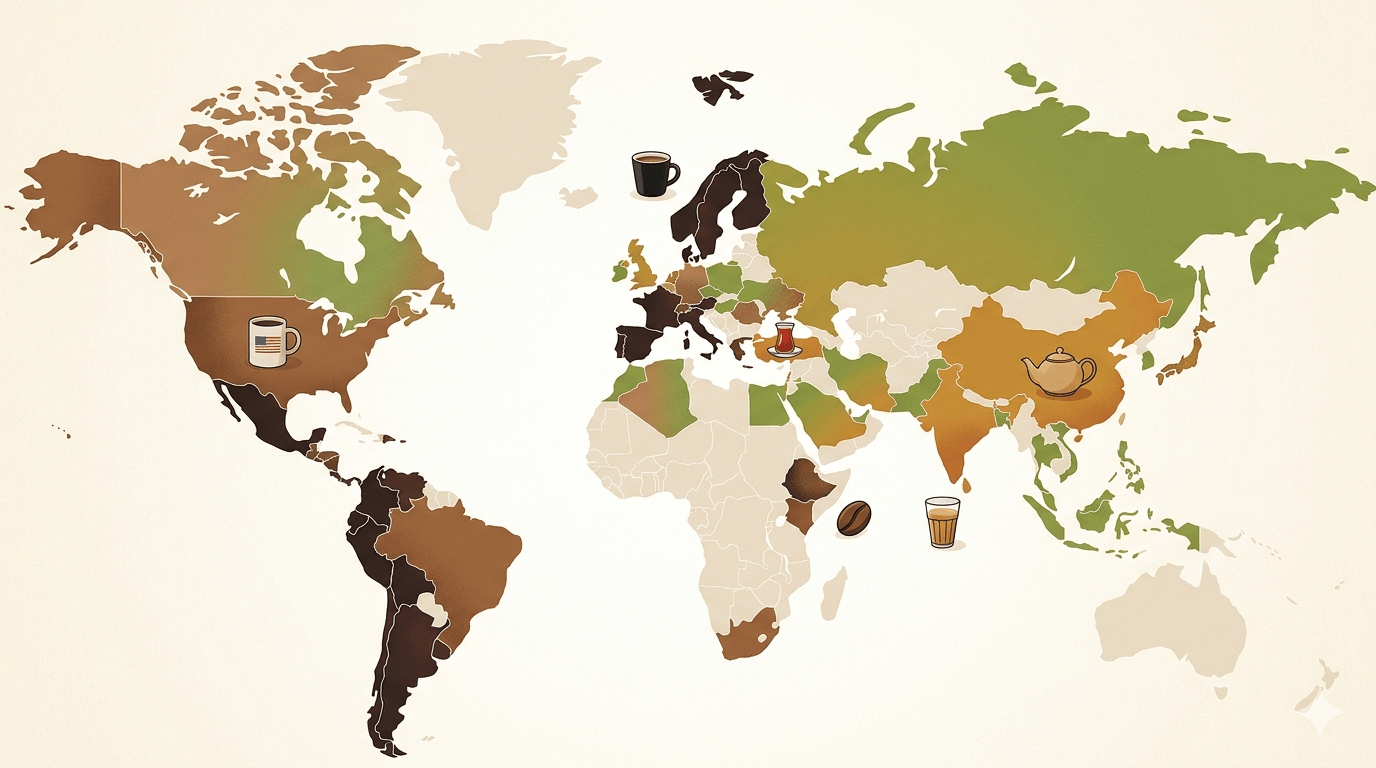
1. the world map: Where is tea drunk - and where is coffee?
If you look at the global consumption data, you will see a surprisingly clear picture: the world is quite clearly divided into tea regions and coffee regions. And the overlap? Surprisingly small.
On the coffee side, the Scandinavian countries dominate by far. Finland leads the world with around 12 kilograms of coffee per capita per year - that's around three and a half cups a day. Sweden, Norway, Denmark and Iceland follow close behind. Central Europe (Germany, Austria, Switzerland), Southern Europe (Italy, France) and Latin America (especially Brazil and Colombia) are also firmly part of the coffee world.
The tea side is much more geographically diversified. Turkey is the undisputed world champion in tea drinking with over 3 kilograms of tea leaves per capita per year. Ireland and Great Britain follow, then Morocco, Russia, Egypt and large parts of South and East Asia - above all India, China and Japan. Tea is also an everyday drink in parts of Africa, particularly in Kenya and Egypt.
What is striking about this distribution is that if you compare the respective top 25 lists, there is almost no overlap. Only four countries worldwide - the Netherlands, Germany, Canada and Switzerland - make it into both rankings. The rule seems to be: heavy coffee consumption and heavy tea consumption are almost mutually exclusive.
But be careful - these data show per capita consumption, i.e. the intensity, so to speak. China, for example, the motherland of tea, only ranks 21st in tea consumption per capita, but of course consumes huge quantities in absolute terms. And the USA is only in 25th place for coffee consumption per capita - but it is still the largest coffee consumer in absolute terms.
2. why the world drinks the way it does: 10 stories
At first glance, the global tea-coffee map looks like a law of nature. But it is not. There is a story behind almost every national preference - and it's usually not about taste, but about politics, wars, trade and coincidence. Here are ten of them.
Turkey - from coffee empire to tea world champion
Turkey is perhaps the most surprising case on this map. This is because the Ottoman Empire was actually one of the largest coffee cultures in history. In the 16th century, coffee spread from Yemen via Istanbul to the entire Islamic world. Istanbul alone had over 600 coffee houses at the end of the 16th century - they were meeting places for poets, chess players and businessmen, a kind of social network avant la lettre. Turkish coffee culture was even recognized by UNESCO as an intangible cultural heritage.
But after the First World War, the newly founded Turkish Republic lost Yemen - and with it access to coffee as a domestic product. Suddenly, coffee had to be imported for hard currency, which the war-torn country did not have. Coffee became a rarity. In 1924, the founder of the state, Kemal Atatürk, ordered that tea cultivation be promoted in the eastern Black Sea province of Rize. The climate there was similar to the Georgian tea regions - and after around a decade of experimentation, production was in full swing.
Today, Turkey is not only the largest tea consumer in the world, but also the fifth largest tea producer. Tea is drunk all day long, from the typical tulip-shaped glasses called "ince belli", almost always black and hot, with a lump of sugar. Around 400 million of these glasses are sold in Turkey every year.
And the coffee? Lives on - as a cultural heritage. Turkish mocha is part of festive occasions and engagement ceremonies, and modern coffee house culture is booming in neighborhoods like Karaköy in Istanbul. But in everyday life, Çay rules.
Great Britain - How a Portuguese princess brought a coffee house nation to tea
What hardly anyone knows today is that England was also originally a coffee country. London's first coffee house opened in 1652, and in the decades that followed, coffee houses became the center of social life - the London Stock Exchange was even built in one of them.
The change began with a wedding. When King Charles II married the Portuguese Princess Catherine of Braganza in 1662, she brought her passion for tea to court. From there, the fashion spread among the wealthy upper classes. The East India Company recognized the business and began importing Chinese tea to Great Britain in 1664.
The rest is trade history: taxes on tea led to massive smuggling, which in turn forced tax reductions. Cheaper tea became affordable for the working class. When the East India Company lost its monopoly on the China trade in the 19th century, it began to cultivate tea in India - making Britain a tea nation for good. To this day, the British drink around 1.5 kilograms of tea per person per year, while the Irish drink almost 2 kilograms.
USA - The revolution that turned a country from tea to coffee
It's hard to believe, but the USA was once a tea country. In the 1770s, the American colonies consumed around 1.2 million pounds of tea per year - it was by far the most popular hot beverage. Coffee existed, but was of secondary importance.
That all changed one December evening in 1773, when the British government granted the East India Company a tea monopoly in the colonies with the Tea Act. On December 16, members of the Sons of Liberty dressed as Mohawk Indians stormed three ships in Boston Harbor and threw 342 chests of tea into the water - the famous Boston Tea Party. What began as a tax protest became a turning point: from then on, drinking tea was considered unpatriotic.
Founding father John Adams wrote in a letter to his wife Abigail in 1774 that he had given up tea and now drank coffee every afternoon. Coffee houses became centers of the revolution - the Green Dragon Tavern in Boston was considered the "Headquarters of the Revolution", where parts of the Boston Tea Party were planned, among other things. After the War of Independence, the change was definitive: coffee became America's patriotic drink.
In the centuries that followed, coffee became deeply embedded in the American identity - from the cowboy campfires of westward expansion to diner culture and Starbucks. Today, the US is the largest coffee consumer in the world in absolute terms, although it only ranks 25th in per capita consumption. The average American drinks two to three cups a day.
India - The country that was taught to drink tea by the British
India is now the second largest tea producer in the world. Over one million people work in the Indian tea industry, and chai - the sweet, milky spiced tea - is the national drink. You can get it on every street corner, on every train platform, at any time of day. But the truth is: India was not a tea country before the 19th century.
The story begins with British calculations. When the East India Company lost its trading monopoly in China in the 1830s, it urgently needed an alternative source of tea. A British officer had discovered wild tea plants in the north-east Indian region of Assam - and the Empire sensed an opportunity. Plantation cultivation began in the 1840s, first in Assam, then in Darjeeling in the foothills of the Himalayas. The botanist Robert Fortune was sent to China and brought 20,000 stolen tea seedlings and Chinese skilled workers back to India.
What followed was one of the largest plantation economies in colonial history - built on the backs of forced labor and under often brutal conditions. The best teas went to England for export. What remained for the Indian population were the inferior leftovers: leaves that were too bitter to drink straight. The solution? They were boiled with milk, sugar and spices - this is how chai was created, the drink that is the soul of India today.
Today, India produces over 900,000 tons of tea per year, and Darjeeling is considered one of the finest tea-producing regions in the world. At the same time, coffee consumption is also growing in India: more and more specialty coffee shops are springing up in major cities such as Mumbai, Bangalore and Delhi, and a young, urban generation is discovering coffee as a lifestyle drink.
Scandinavia - alcohol bans, dark winters and the culture of fika
Finland, Sweden, Norway - these countries drink more coffee than anyone else in the world. Finnish trade unions have even enshrined coffee breaks (kahvitauko) in employment contracts. But why the far north of all places?
The explanation is a mix of climate, politics and culture. The long, dark winters make hot, caffeinated drinks a kind of survival strategy. Coffee warms you up, keeps you awake and is the social lubricant of Nordic society. Sweden even has its own word for it: fika - the coffee break with pastries, which is as much a part of the working day as the lunch break.
Historically, a rather unexpected factor helped: alcohol prohibition. When strict alcohol restrictions were in place in Sweden, Norway and Finland in the 19th and early 20th centuries, a socially accepted beverage was needed. Coffee took on this role - and never relinquished it. The fact that coffee was even banned several times (!) in Sweden (most recently in 1817) only made it even more popular.
Today, around 86 percent of Swedish adults drink coffee regularly. The Nordic coffee culture focuses on filter coffee, often black, in large quantities and high quality. Scandinavia is also a stronghold of the specialty coffee scene and prefers light roasts - a clear contrast to the espresso south of Europe.
Ethiopia - where coffee was born
Ethiopia is the motherland of coffee, and here it is much more than just a drink. Legend tells of a goatherd named Kaldi whose animals became particularly lively after eating red berries. Nobody knows whether the story is true, but it is certain that coffee originated in the Ethiopian region of Kaffa.
What makes Ethiopia special is that coffee is not a quick morning kick here, but an extended ritual. The Ethiopian coffee ceremony (buna) often lasts an hour or longer. The beans are roasted in front of the guests, ground and brewed three times in a traditional clay pot (jebena). This is accompanied by incense and popcorn. It is an act of hospitality and community.
Ethiopia is one of the top 10 coffee consumers in the world in absolute terms - which is remarkable given that the country is also one of the largest coffee exporters. A significant proportion of the harvest is consumed domestically, often in informal, domestic ceremonies that are not fully recorded in official trade statistics.
Japan - The only major nation that cultivates both at a world-class level
Japan is a fascinating special case. On the one hand, the country has a centuries-old tea culture: the Japanese tea ceremony (chado) is a meditative art form, while matcha and sencha are deeply rooted in everyday culture. On the other hand, Japan is the third largest coffee consumer in the world in absolute terms.
How does that fit together? Japan has not adopted coffee as a substitute for tea, but as a parallel culture. Since the 1960s, there have been kissaten - traditional Japanese coffee houses with filtered coffee, classical music and an almost ceremonial atmosphere. Japan has also perfected canned coffee: You can pull hot or cold coffee around the clock from over five million vending machines in the country.
The result is a culture in which a cup of pour-over coffee is just as commonplace as a bowl of matcha. Japan shows: The division between tea and coffee nation need not be absolute - if a society takes both drinks seriously as their own cultural form.
Germany - a coffee country with a tea island
Germany is one of the few countries in the world to make it into the top 25 for both coffee and tea consumption. On average, Germans drink around 160 liters of coffee per year - significantly more than beer (around 90 liters). At the same time, the country also consumes considerable quantities of tea, especially in the north.
Germany has a real tea island: East Frisia. The region on the North Sea coast cultivates a tea culture that is unparalleled worldwide. With an estimated 300 liters of tea per capita per year, the East Frisians drink more than the British and almost as much as the Turks. The East Frisian tea ceremony - with Kluntje (rock candy), a dash of cream and the requirement to drink at least three cups - is even recognized as intangible cultural heritage in Germany.
The explanation for this is geographical and historical. Thanks to its coastal location, East Frisia had direct access to the trade routes of the Dutch East India Company, which had been importing tea from Asia since the 17th century. While the rest of Germany turned to coffee - not least because of Frederick the Great, who taxed coffee but was unable to stop its consumption - East Frisia remained loyal to tea.
In the south and west of the country, on the other hand, coffee clearly dominates. Munich, Berlin and Hamburg have a thriving specialty coffee scene. Germany is also the second largest coffee importer in the world and an important center for roasters.
Poland - Europe's underestimated tea nation
Poland surprises many: It is one of the biggest tea drinkers in Europe and ranks eighth in the world in terms of per capita consumption, with around one kilogram of tea per person per year. Tea is drunk with almost every meal in Poland - in the morning, at lunchtime and in the evening. Black tea with lemon is the classic, while milk in tea is rather unusual.
The history of tea in Poland begins in the 17th century at the royal court. King Jan Kazimierz and his wife Maria Ludwika brought the tea fashion to Poland, initially as a medicine in pharmacies. Interestingly, Poland was a coffee country for a long time - at the end of the 18th century, 470 tons of coffee were sold, but only 19 tons of tea. It was not until the 20th century that the ratio changed: coffee had to be roasted and was expensive to prepare, while tea could be brewed immediately and was cheaper.
Russian influence also played a role: the Russian tea tradition came to eastern Poland via the samovar, and the habit of drinking tea from glasses instead of cups - so that you can judge the color and strength - has persisted in parts of the country to this day. What is changing, however: Younger generations in Poland are increasingly turning to coffee. Coffee sales have risen by around 80 percent in the last decade.
China - the cradle of tea discovers coffee
China is the birthplace of tea. Tea has been cultivated, prepared and revered here for several thousand years - from the meditative Gongfu ceremony to the quick jasmine tea on the street corner. Together with Japan, China consumes over 40 percent of the tea produced worldwide. Nobody is shaking the tea throne.
And yet China is currently experiencing a coffee boom that is unparalleled in the history of beverages. Luckin Coffee, founded in 2017, now operates over 26,000 stores in China - more than Starbucks has there. The company's turnover rose to the equivalent of around 7 billion US dollars in 2025. Over 94 million customers buy their coffee there every month - ordered via app and picked up in minutes. In addition, another competitor, Cotti Coffee, is growing rapidly and already has over 14,000 stores.
What is driving this boom? Young, urban Chinese people in particular see coffee as part of a modern, cosmopolitan lifestyle. In cities such as Shanghai, Beijing and Shenzhen, coffee in the morning is already part of the routine for many. This gives rise to their very own creations: Sparkling Apple Americanos, coconut lattes, coffee-tea mixers - Chinese coffee culture doesn't copy, it reinvents.
At the same time, China is growing its own coffee. Arabica beans are now growing in the southern province of Yunnan, including specialty varieties such as Geisha and Yellow Bourbon. The government is specifically promoting cultivation - coffee as an economic factor for rural regions.
Per capita consumption of 0.15 kilograms per year is still far below the world level. But that is precisely what makes the potential so enormous: if China were to reach even the global average of 1.36 kilograms, it could overtake the USA as the world's largest coffee market.

3. half the truth: do coffee countries really not drink tea?
Up to this point, you might have thought the world was neatly divided into two parts: Coffee here, tea there. Nice graphics, clear colors. But if you take a closer look, you soon realize that the world map of hot beverages only shows half the truth at best.
Take Turkey: yes, the Turks drink more tea than any other nation. But the Turkish mocha has not disappeared because of this - it remains a UNESCO-recognized cultural heritage and is an integral part of engagements, special occasions and the booming café scene in Istanbul's younger districts.
Or Great Britain: The nation of tea time has been experiencing a specialty coffee boom for years. There are now thousands of independent coffee roasters and cafés in London. Per capita tea consumption in the UK has fallen from over 2 kilograms to around 1.5 kilograms in the last 20 years - while coffee is steadily increasing.
As we have seen,Germany is a prime example of coexistence: tea in the north, coffee in the south, and both in the middle. And Poland, the classic tea country, is recording the strongest growth in coffee in Eastern Europe.
The pattern works the same the other way round. Finland, the coffee world champion, has a very lively tea culture - it is just less visible. The USA, which became a coffee country through a tea party, has been recording rising tea sales for years - especially among young consumers who are discovering matcha and chai for themselves. In Japanese convenience stores, canned coffee and bottled tea stand side by side. And in Ethiopia, the birthplace of coffee, tea is also drunk in many regions - so-called shay, often with spices. India, on the other hand, which was shaped into a tea nation by the British, is experiencing a rapid coffee boom in its major cities.
The message: tea country or coffee country - this is a useful simplification, but not a complete description. In reality, almost the entire world drinks both. What differs are the proportions, the rituals and the cultural significance.
4 When boundaries blur: Where the journey is headed
The clear dichotomy of the hot drinks world - coffee here, tea there - is becoming increasingly blurred. And this is not because people suddenly taste differently. It is due to globalization, urbanization and a generation that knows both.
China's coffee explosion is the most prominent example, but by no means the only one. In India, the world's second largest tea producer, specialty coffee shops are springing up in the major cities. In South Korea, one of the densest café cultures in the world has developed in just a few decades. And in traditional coffee countries such as Italy, a young generation is discovering matcha and chai latte.
What is driving this development is often the same force that brought tea to England and coffee to Vienna in the 17th century: Curiosity, trade and the need for something new. The Third Wave Coffee movement, which treats coffee like wine - with a designation of origin, roasting profile and preparation method - has gained a foothold worldwide. At the same time, high-quality tea is experiencing a renaissance: matcha ceremonies in Berlin, pu-erh tastings in New York, craft tea stores in Tokyo and Seoul.
At the same time, hybrids are being created that deliberately blur the line between tea and coffee. Dirty Chai (chai latte with espresso shot), Yuenyeung (a coffee-tea mix from Hong Kong) and the increasingly creative drinks menus of Chinese coffee chains are proof of this: For a new generation of connoisseurs, the question is no longer "tea or coffee?" - but "What fits right now?"
And perhaps that is the most beautiful insight from this world map: whether Turkish Çay or Finnish filter coffee, East Frisian tea ceremony or Ethiopian buna - in the end, both drinks are about the same thing. About community. About ritual. About the moment when you sit down, pick up a cup and the world stands still for a moment.
In both cases, the more consciously you enjoy it, the better it tastes.
About the autor:

Mitgründer von Honest & Rare

Mich begeistern Getränke aller Art. Ob Bier, Gin, Weinbrand, Cold Brew Kaffee oder Limo. Vor allem liebe ich die Kultur, regionalen Bezüge und Herstellung von Getränken. Selbst braue ich ab und an Bier, setze Liköre an und röste Kaffee in der Pfanne.
- Liebt: Rätsel, Poesie, Abenteuer
- Favorite drinks: Whisky, süffige Biere, Limos
- Empfehlung des Monats: Momotaro Ginzero Alkoholfreier Gin
Recent articles
-
01 JulRare Teas as Collectibles: What Connoisseurs Appreciate
-
28 JunVintage Lamps as an Interior Design Trend
-
25 JunHausberg Single Malt Whiskey for Collectors and Connoisseurs—the second cask has arrived!
-
21 MarTea or coffee? A world map of hot beverage enjoyment
-
24 FebCoffee drinks from A to Z: The big encyclopedia of all coffee drinks
-
17 FebAll about table salt: Fleur de Sel, sea salt, rock salt & co. - differences, origin & use
-
07 JanDirect juice meets carbon dioxide - why PENG doesn't want to be a soft drink
-
27 AugBetween needle & nose: tattoos, dragons and bananas in a jar
-
03 JulOrange disco on the tongue: the founding story of Satoshi Spirits


