 Quality instead of quantity!
  9,500 independent products
  No mainstream
  No mainstream here



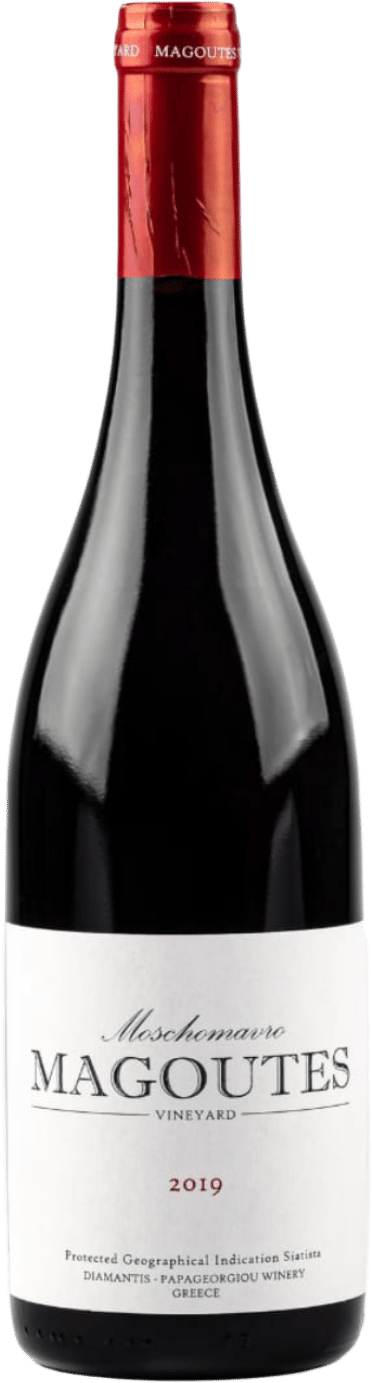


More information about Magoutes Moschomavro
Although Moschomavro means “black Muscat,” it is not genetically related to the white variety Muscat Blanc à Petits Grains (Moschato Aspro in Greece), and you won’t detect any Muscat aromas. The grape variety is grown almost exclusively in the mountainous region of Siatista, southwest of Kozáni in Western Macedonia. The fact that the variety is now flourishing again—albeit on a very small scale—is primarily thanks to Magoute.
The variety’s typical role was to “fortify” Xinomavro (i.e., increase its sugar content), which often had difficulty ripening fully. Diamantis is currently the only producer making a 100% Moschomavro wine, and there are only a few producers left who use it in a red or rosé blend.
Winemaking at Magoutes involves minimal intervention; the wine is fermented with indigenous yeasts and aged in stainless steel. The resulting wine features aromas of red and black plums, strawberries, and floral notes, with soft tannins and a hint of pepper on the finish. For a wine that seems relatively light, it has a surprisingly lingering finish.
A good pairing for duck, pork, and vegetarian dishes with mushrooms.
| Contents: | 0,75 Liter |
| Type of wine: | Red wine |
| Beverage type: | Wine |
| Quality level: | PDO |
| Expansion: | Stainless steel |
| Alcohol: | 13 |
| Closure: | Cork |
| Shelf life: | 3-5 Jahre |
| Contains sulfites: | Yes |
| Country: | Greece |
| Place: | Siatista |
| Weingut: | Magoutes Winery |

Magoutes Winery
Das Weingut Magoutes befindet sich in Siatista, einer Stadt in der trockenen Bergregion Makedonien im Nordwesten Griechenlands. Ein Merkmal, das das Gebiet von Siatista von seinen Nachbarn unterscheidet, sind seine Böden, die überwiegend aus Kalkstein bestehen, der den Weinen angeblich mehr Auftrieb und Säure verleiht, die dieser Wein im Überfluss hat – und nicht aus Ton. Die hochgelegenen Weinberge profitieren hier von kühlen Brisen, die auch zur Frische der Weine beitragen, indem sie den Trauben helfen, die Säure zu erhalten. Bei minimalen Umweltbelastungen in der Region sind biologischer Anbau und ein praxisorientierter Ansatz eine natürliche Wahl.
Read more


